

There was a school trip to the pool your kid found a reason to miss. A pool party they said they were sick for. A cottage weekend spent on the dock holding everyone’s phone.
If your teenager can’t swim, you’ve probably noticed the avoidance long before you noticed the gap in skills. And when you brought it up, the answer was some version of “I’m fine, I don’t need it.”
Here’s the thing worth understanding before you argue about it: your teen almost certainly isn’t refusing because of the water. They’re refusing because being the oldest beginner in the room is humiliating at fifteen in a way it simply isn’t at five. Any conversation about teen swimming lessons in Toronto that skips past that goes nowhere.
This guide covers how common late starts actually are, what a beginner class for teenagers involves, how quickly a motivated fourteen-year-old can progress, and how to have the conversation without making it worse.
More Teens Can’t Swim Than You’d Guess
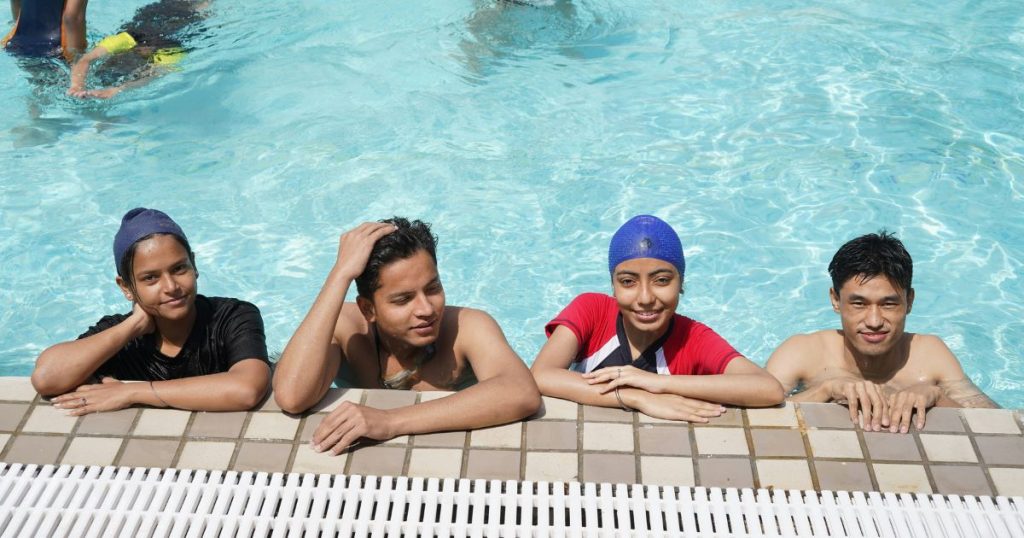
The assumption that everyone learned at six is wrong, and it’s worth saying out loud to your kid.
Canadian numbers on adult swimming ability are sobering. One recent look at adult beginner programs cited a Red Cross figure that around half of Canadian adults can’t pass a basic swim test. Those adults were all teenagers once. The gap doesn’t appear at thirty.
Access explains a lot of it. Research from the Lifesaving Society, reported by CBC, found that newcomers to Canada between eleven and fourteen were considerably less likely to know how to swim than Canadian-born peers, often because pools, beaches or lessons simply weren’t available where they grew up. In a region as diverse as the GTA, that’s a common story rather than an unusual one.
There’s also a cohort of kids who lost two or three years of lesson time during the pandemic pool closures and never picked it back up. They’re in high school now.
None of this is a moral failing. It’s a scheduling accident, a money question, or a family that moved. Your teen should hear that.
Why Teenagers Learn Differently Than Six-Year-Olds
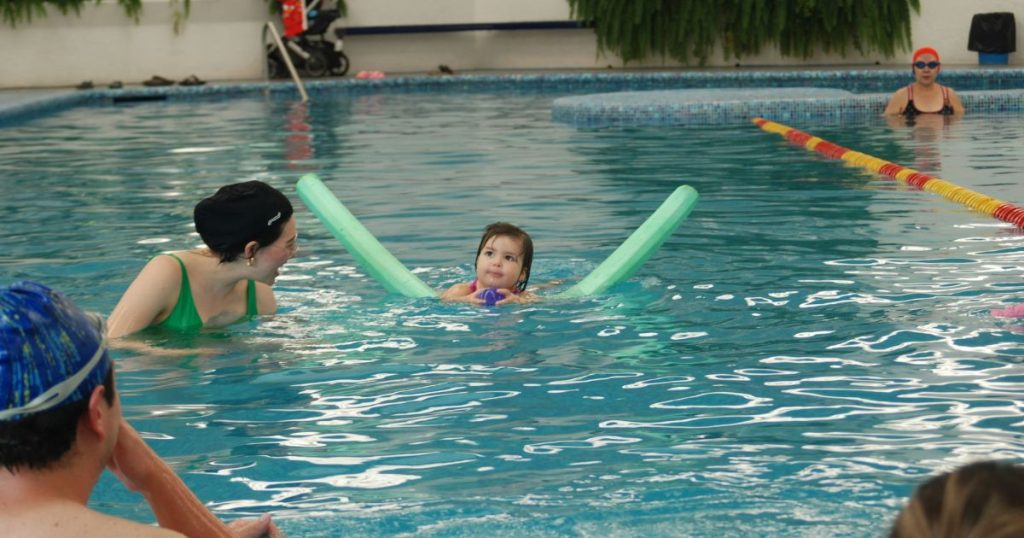
Teens have real advantages as beginners, and one significant obstacle.
Instruction sticks. You can explain to a fifteen-year-old why lifting the head sinks the hips, and they’ll adjust. A five-year-old needs the same correction forty times.
They can self-correct. Teens notice what their own body is doing, which means practice between lessons actually improves things instead of grooving bad habits.
They’re there on purpose. A teen who has decided to learn is a genuinely good student. Motivation isn’t borrowed from a parent.
The obstacle is self-consciousness, and it’s not trivial. Industry research on adult learn-to-swim programs identifies three consistent barriers: no access to lessons in childhood, anxiety from a past water experience, and embarrassment about learning late. All three show up in teenagers, usually the third most strongly.
Self-consciousness isn’t only social. It’s physical. A tense swimmer lifts their head, stiffens their neck, and kicks harder than necessary, which makes them sink rather than float. The sinking confirms the belief that they can’t do this. Relaxation is a technical skill for teen beginners, not a mood.
Which is why the format matters enormously. A fourteen-year-old placed in a class of eight-year-olds usually attends twice and quits. Teen swimming lessons need to be with peers, or one-on-one, or they don’t last.
What Happens in Beginner Teen Swimming Lessons
Less than your kid is imagining. Nobody is going to ask them to swim a length on day one.
The first session
Getting comfortable, mostly. Standing in chest-deep water, putting their face in, blowing bubbles, getting used to how breathing feels when it isn’t automatic. Then floating on the back, which is the foundation for everything else and the thing most beginners skip past too quickly.
Building to a length
Kicking with a board, then front crawl arms, then the hard part: putting breathing and stroke together. This is where most teens plateau for a few weeks. Rhythmic breathing feels unnatural until suddenly it doesn’t.
Survival skills, which matter more than a pretty stroke
Treading water, rolling into deep water and recovering, swimming a short distance in clothes. The Lifesaving Society’s Swim to Survive standard is built around exactly this: assessing the situation, rolling into deep water, treading for one minute and swimming 50 metres. The same reporting notes that most drownings happen close to safety, which is why a short, reliable swim matters more than a long, elegant one.
For a teenager, that’s a useful reframe. The goal isn’t to look like a competitive swimmer. It’s to be able to get themselves out of the water.
Alex’s Swim School teaches beginners from age three upward, including teenagers, with certified instructors and small classes so an older beginner isn’t stuck in a group of small children.
How Fast Can a Teenager Learn to Swim?
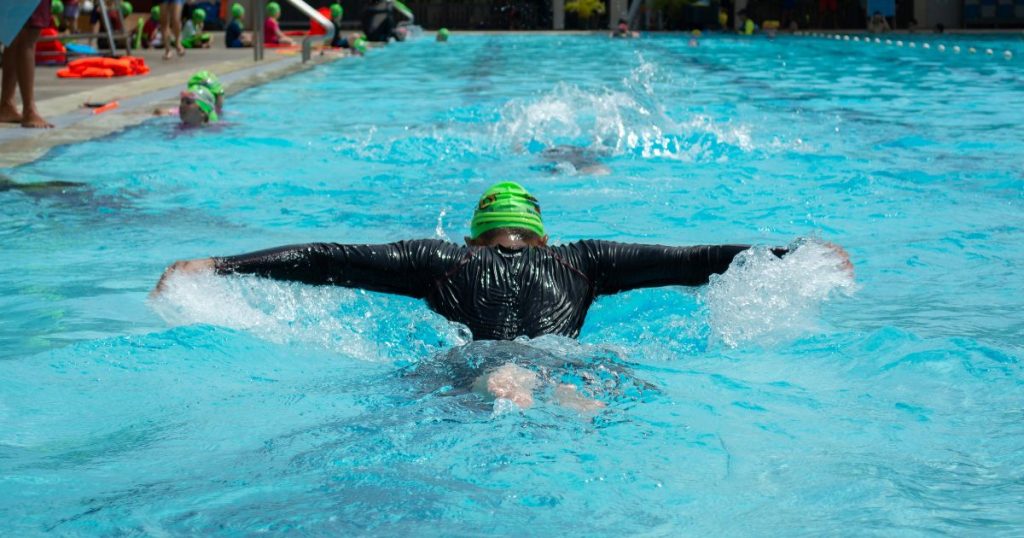
Faster than most parents expect, with the usual caveats.
A motivated teenager with no strong fear, attending twice a week, will often be swimming a basic front crawl length within eight to twelve weeks. Comfort at the deep end and reliable treading usually arrive before the stroke looks good.
A teen who is genuinely anxious in water takes longer, because the first stretch is spent on relaxation rather than technique. Two or three months before real progress isn’t unusual, and it isn’t a sign anything is wrong.
Frequency does more than session length. Two thirty-minute sessions a week beats one hour, because the skills are motor patterns and they consolidate with repetition. Our post on how many lessons it takes to swim goes through typical ranges in more detail. Nobody can promise your teen a timeline, and any program that does is guessing.
Talking to a Teen Who Doesn’t Want Lessons
The safety argument is true and it does not work. Fifteen-year-olds do not experience themselves as vulnerable, and the more you push the risk angle, the more it sounds like nagging.
What actually moves teenagers:
A job. Lifeguarding pays well, hires locally, and looks good on a first résumé. Aquatics departments across the GTA have struggled with staffing for years. That’s a concrete reason to learn, with a paycheque at the end.
Camp and travel. Counsellor roles, canoe trips, a class trip involving water, a friend’s cottage. Anything where not swimming means sitting out.
Fitness, framed their way. Swimming is low-impact and hard, which appeals to teens already in sports and to teens who hate running. Alex’s Swim School sees both kinds sign up.
Control. Let them pick the format, the time and whether a parent watches. A teen who chooses private lessons because they’d rather not have an audience has just solved their own biggest barrier. That’s a good outcome, not avoidance.
It also helps to point out that adults do this constantly. Our guide to adults working through fear of water exists because beginner classes for grown-ups in Toronto fill up every session. Being sixteen and learning is early, not late.
One more thing: let it be their decision if you possibly can. A teen dragged to lessons attends. A teen who signed themselves up learns.
Where Teen Swimming Lessons Lead: Bronze Awards and a Summer Job

This is the part that turns a late start into an advantage, and it’s worth showing your teen the pathway early.
The certification ladder in Ontario runs Bronze Star, then Bronze Medallion, then Bronze Cross, then National Lifeguard. According to the YMCA of Greater Toronto’s aquatics pathway, National Lifeguard requires a minimum age of fifteen along with Bronze Cross and Standard First Aid. Teaching swimming has similar prerequisites: the Lifesaving Society Swim Instructor course requires candidates to be fifteen by the end of the course and to hold Bronze Cross.
The realistic runway looks like this. A beginner at fourteen who is consistent can be a competent swimmer within a year, start Bronze Star at fifteen, and be certifiable for aquatic work by sixteen or seventeen. That’s tight but it happens, and it depends entirely on getting the first year of swimming done.
Alex’s Swim School runs Bronze Medallion, Bronze Cross and First Aid courses through its partnership with the Lifesaving Society, so the path from beginner to certification doesn’t require starting over somewhere new. If your teen is closer to that stage already, our overview of Bronze courses and lifeguarding in the GTA covers what each award involves.
Is It Too Late for My Teenager to Learn to Swim?
No. And the framing is backwards.
Teenagers learn motor skills well. They understand instructions, they can practise deliberately, and they can articulate what feels wrong. Plenty of late starters overtake kids who had lessons at six and forgot most of it.
The honest qualification is that a teen who never learned may carry more tension into the water than a small child does, so the early weeks can feel slower. That’s an emotional starting point, not a physical limitation, and it passes.
Fitting Teen Swimming Lessons Around Homework and a GTA Winter
Scheduling is where good intentions die, so plan for the real version of your week.
Indoor pools across Toronto, Scarborough, Markham and Vaughan run all year, which makes winter a better time to start than summer for teenagers. Nothing competes with lessons in February. There’s no camp, no cottage, no outdoor sport, and the sessions are easier to get into. Our post on staying active indoors through a Toronto winter makes the wider case for it.
Once a week works if that’s what fits. Twice works better. The best schedule is the one your teen will actually keep for ten straight weeks, and a schedule they picked has a much better survival rate than one you picked for them.
Getting there matters too. A pool your teen can reach by TTC on their own removes you from the equation, which for a self-conscious sixteen-year-old is worth more than a slightly better program that needs a parent driving.
Frequently Asked Questions
Is my teenager too old to start swimming lessons?
No. Teens learn quickly because they can follow instructions and practise deliberately. The main challenge is self-consciousness, which is best handled by putting them with peers or in private lessons rather than in a class of young children.
Can teenagers take private swimming lessons instead of a group class?
Yes, and for many older beginners it’s the better choice. One-on-one removes the audience, which is usually the real barrier, and lets the instructor work at whatever pace suits.
How long before my teen can swim a full length?
For a motivated teen attending twice a week without strong water anxiety, roughly eight to twelve weeks is a common range. Anxious beginners take longer because the early sessions focus on relaxation. Everyone moves at a different speed.
What should my teen bring to a first lesson?
A swimsuit they feel comfortable in, a towel, goggles, and a swim cap if the pool requires one. Comfort in what they’re wearing matters more than people expect for a self-conscious beginner.
Can my teen still become a lifeguard if they start now?
Yes, provided they start soon. Bronze Cross and a minimum age of fifteen are the gateways to lifeguard and instructor certification, so a beginner at fourteen or fifteen who trains consistently can realistically be certifiable within a couple of years.
Getting the First Lesson Booked
Three things worth remembering. Late starters are far more common than your teen believes, and telling them so is the single most useful thing you can do. Teenagers learn fast once the embarrassment is handled, which usually means peers or private lessons rather than a mixed class. And the format your teen chooses beats the one you choose for them.
Start by asking what would make it bearable: a private lesson, a friend joining, a pool where nobody from school goes. Then book that one.
Alex’s Swim School teaches teen beginners across Toronto, Scarborough, Markham and Vaughan, with flexible scheduling for families working around school and part-time jobs. You can get in touch here or call 647-458-0481 if you’d rather talk it through first. Questions welcome, including the awkward ones your teen won’t ask.